
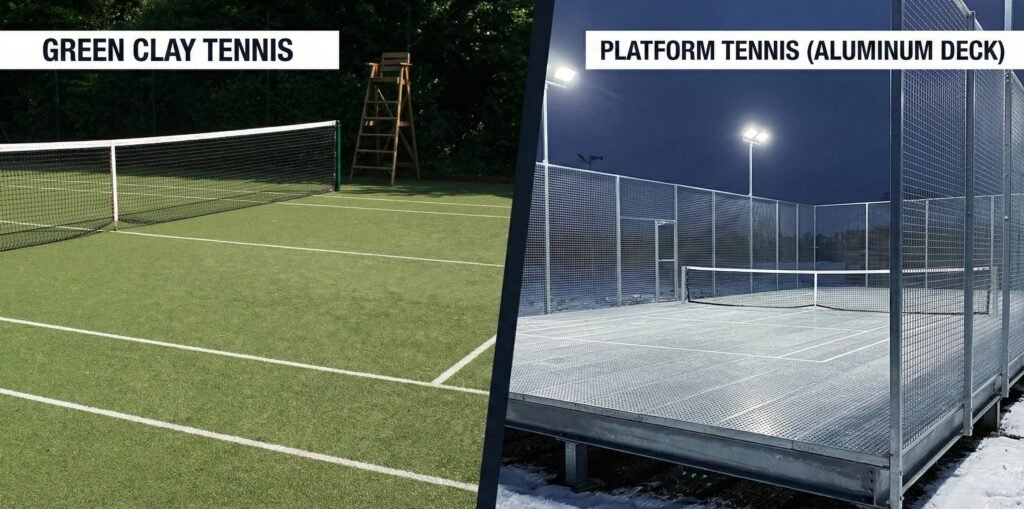
Why Tennis Players Are Entering “The Cage”
If you are a tennis player living in a colder climate, you have likely driven past them: raised, chicken-wire cages glowing under floodlights on a snowy Tuesday night. You might see players laughing, hitting a ball that sounds closer to a thudthan a ping, and wondering, “Is that just mini-tennis?”
That is Platform Tennis—often simply called “paddle.”
While it shares DNA with traditional tennis—including the scoring system and the basic volley mechanics—it is a distinct tactical beast. For the uninitiated, the transition can be jarring. The power that wins you points at the baseline in August will often lose you points in the cage in January.
In this guide, we break down the seven critical differences between platform tennis vs. tennis, so you can decide if you’re ready to trade your strings for a paddle this winter.
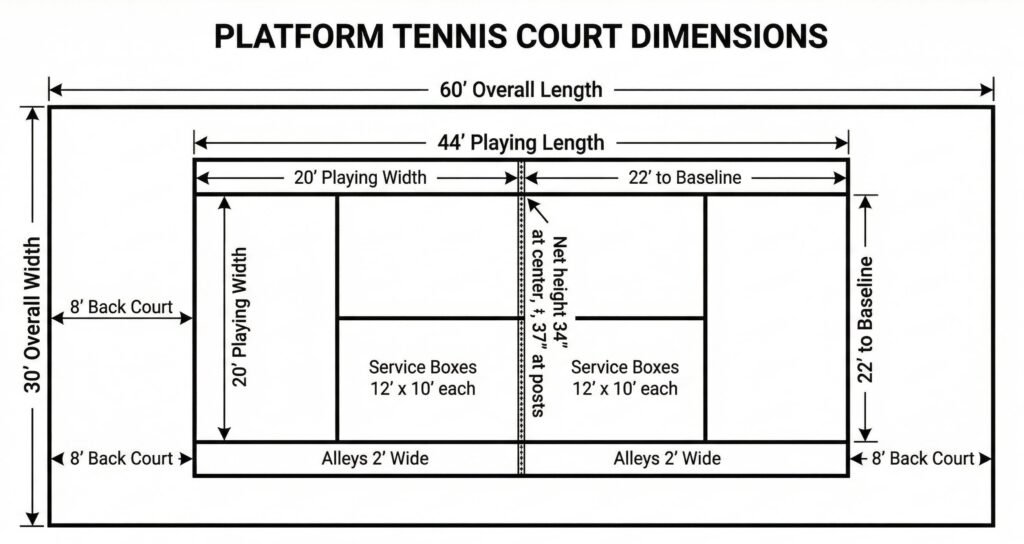
1. The Court: Size, Surface, and “The Deck”
The most immediate visual difference is the arena itself. A standard tennis court is a massive expanse—78 feet long by 27 feet wide (singles) or 36 feet wide (doubles).
A platform tennis court is significantly more intimate.
- Dimensions: The total playing area is 44 feet long by 20 feet wide. This smaller footprint creates a faster-paced, reflex-heavy game where net play is dominant.
- The “Platform”: Unlike tennis courts which sit on the ground (clay, grass, or hard court), a platform tennis court is raised on a superstructure. This allows for heaters to be installed underneath the floorboards (the deck) to melt snow and ice, making it the ultimate winter warrior sport.
- The Surface: Tennis players are used to sliding on clay or gripping on hard courts. Platform tennis courts are made of aluminum planks covered in a gritty, sandpaper-like material (silica and paint). This “grit” is essential for traction in wet or icy conditions and imparts massive spin on the ball.
2. The Screens: It’s Not Just a Fence
In traditional tennis, if the ball passes you and hits the back fence, the point is over. You lost.
In platform tennis, the fence is your friend. This is the “Squash” element of the sport. The court is surrounded by 12-foot high, tight-gauge wire fencing (the “screens”).
- The Rule: If the ball bounces in your court and then hits the screen, the ball is still “live.” You can wait for it to rebound off the wire and return it before it hits the ground a second time.
- The Tactic: This changes everything. A tennis player’s instinct is to smash a winner. A platform tennis player knows that a hard smash will just bounce off the back screen and float nicely for the opponent to attack. This neutralizes pure power and rewards patience.
Pro Tip: Learning to read the spin off the screens is usually the hardest adjustment for players transitioning from our weekend tennis programs, where the back fence is strictly out of bounds.

3. The Gear: Paddles vs. Racquets
Leave your strung racquet in the bag. The equipment here is designed for durability and cold weather.
- The Paddle: Platform tennis is played with a composite paddle (fiberglass, graphite, or carbon/kevlar). It is solid, roughly 18 inches long, and filled with a high-density foam core. Instead of strings, the face has drilled holes to reduce air resistance. It feels heavier and less “springy” than a tennis racquet.
- The Ball: You won’t hear the pop of a pressurized felt ball. Platform tennis uses a sponge rubber ball with a flocked coating. It is heavier and much slower than a tennis ball. Because it isn’t pressurized, it doesn’t bounce as high, especially in extreme cold.
4. The One-Serve Rule
If you rely on a booming first serve to get free points in tennis, you are in for a surprise. In platform tennis, you only get one serve.
If you miss your serve, you lose the point immediately.
- Why this matters: This rule eliminates the high-risk, high-reward “ace” culture of modern tennis. The goal of the serve in paddle is simply to start the point without giving the opponents an easy attack. It forces players to serve with spin and placement rather than raw heat.
If you are currently taking private tennis lessons to improve your kick serve, that skill will transfer beautifully here. A heavy kick serve that stays low is the gold standard in platform tennis.
5. The Strategy: Patience Over Power
This is where the “Semantic” shift happens.
- Tennis is often a game of passing shots and winners. You see an open court, and you hit it.
- Platform Tennis is a game of errors. Because of the screens, it is incredibly difficult to hit a clean winner. The court is small, the reflex volleys are fast, and the screens give you a second chance on deep balls.
Points in platform tennis can last 30, 40, or 50 shots. The team that wins is usually the one that stays patient, lobbing the ball high and deep to push the opponents back, waiting for them to make a mistake into the net. If you try to blast your way through a paddle match, you will lose to the screens.
6. Seasonality: The Winter Game
Tennis has an offseason in many parts of the world. Platform tennis is the offseason.
The sport was literally invented to give tennis players something to do in the winter. The balls and paddles are designed to perform in freezing temperatures. While you can play year-round, the “real” season runs from October to March.
Many players view platform tennis as the perfect complement to their yearly routine—playing tennis in the sun and paddle in the snow, ensuring their hand-eye coordination never gets rusty.
7. The Culture: The “Hut” Factor
Finally, there is a distinct cultural difference. While tennis clubs obviously have social elements, platform tennis is famous for the “Warming Hut.”
Because the sport is played in freezing cold, the courts are almost always attached to a small lodge or hut with a fireplace, viewing deck, and bar. Matches are often played socially, with players rotating out of the cold and into the warmth.
If you enjoy the social camaraderie found in our weekend tennis programs, you will likely find the platform tennis community even tighter-knit. The shared adversity of battling the elements creates a unique bond among players.
Conclusion: Which Sport is Right for You?
You don’t have to choose. The beauty of Platform Tennis vs. Tennis is that they support each other. The volleying skills you learn in the “cage” will make you a formidable net player when you return to the tennis courts in the spring.
Ready to give it a try? Before you step onto the aluminum deck, you’ll need to understand the flow of the game. Check out our upcoming guide on the Rules of Platform Tennis or browse our current guide to private tennis lessons to brush up on your fundamental volley mechanics first.